Despite all the enemy’s policies of tyranny, denial, and annihilation, we continue to fight. In defiance of the rulers, we will never abandon Botan, Serke Deryan, Axyan, or the Hezil valley.
We will fight selflessly for the freedom of Kurdistan and all oppressed peoples, and we will continue the struggle to the last drop of our blood.
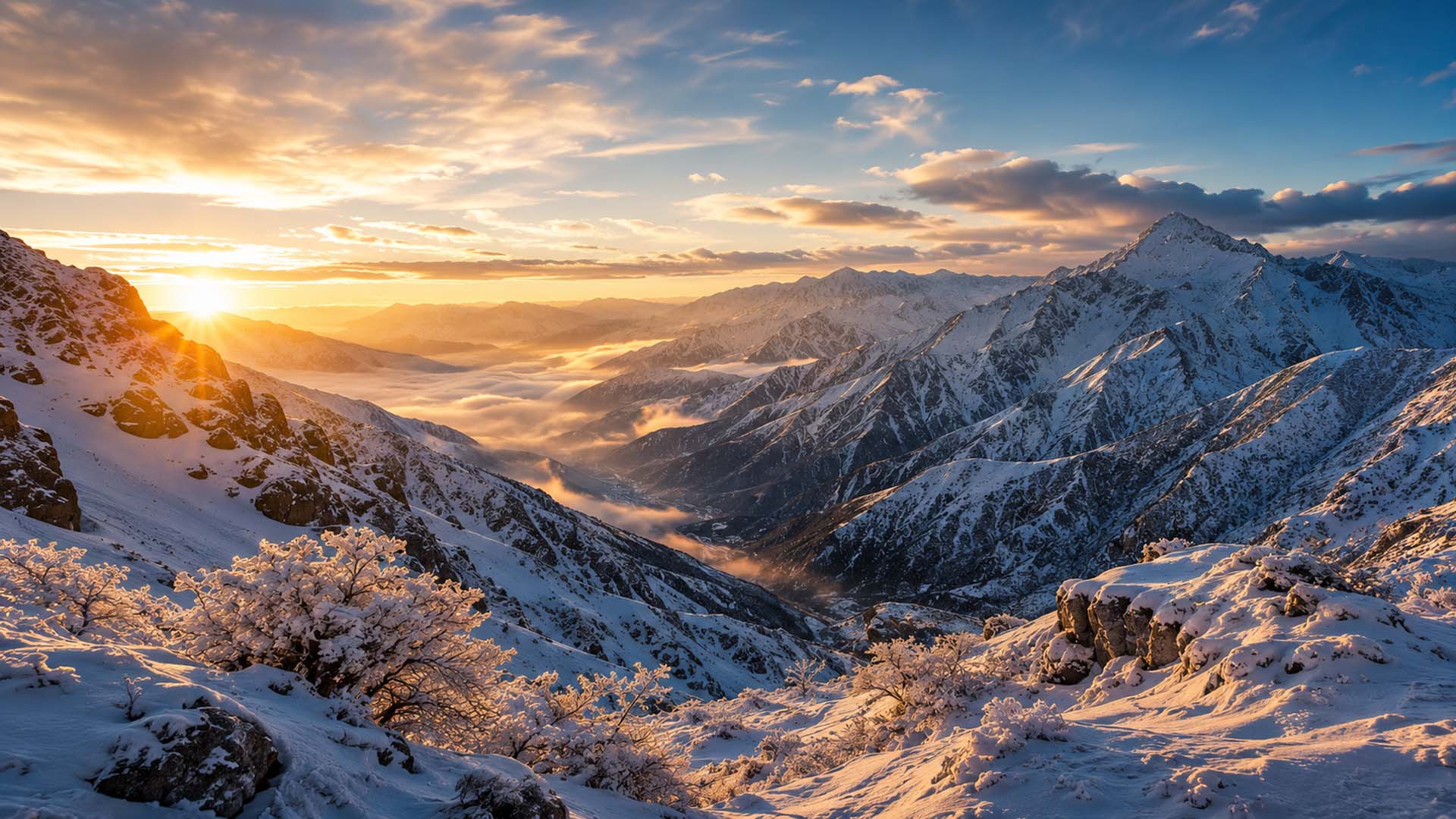
We had taken our winter position with a battalion-sized force on the slope of Serke Deryan facing Axyan. We had just begun to pass from the silence of the snow toward the colors of spring. Despite the freezing cold of the weather and all its hardships, we were approaching March, the herald of spring. We were leaving “mad February” behind, but this March would pass differently from other Marches. Just as we thought we had escaped winter, snow began to fall on the first day of March. The snow would not stop. Everywhere had turned white once again. Nature had once again clothed itself in a single color. The sun was warming and illuminating everywhere with its rays. The most beautiful sight was the unique scene formed by the merging of a pure white cover with the deep blue sky. Our eyes were enchanted, as if we had never before seen such a landscape. Snowflakes shone like jewels. Nature was once again offering all its beauty to what it had created.
March 7…
Directly below us was the village of Axyan. Above us, where the scouts had gone, the village of Hasyan, near Kani Botke, stood before us. On our other side was Serke Deryan, and a little below it there was a cave facing the camp. Preparations for morale had been made for March 8, International Working Women’s Day, but because of the conditions of the place where we were staying, we would celebrate one day early, on the night of March 7. Within the limits of our possibilities, we had prepared a beautiful program.
It was our team’s turn to go to the hill. Since one stayed on the hill for three days, we began making our preparations. But our company commander said that we would take part in the morale program and go to the hill toward morning. Although we said it was not right for that place to remain empty in the snow, he said nothing would happen. And so we celebrated March 8 one day earlier.
March 8…
The comrades in the battalion were going to leave for their duty. We were planning to spend a calm day on the hill. Around two or two-thirty at night, the comrades woke us so that we could go to the hill. As a squad, we put our bags on our backs and our weapons on our shoulders. Under the shining stars of the night, together with a squad of women comrades, we set out toward Serke Deryan.
Because the falling snow had frozen, we could walk easily without sinking into it. When we began climbing the slope, we struggled a little, because the comrades who had come down from the hill before us had slid down; the path had frozen and was no longer a path. When the pace became heavy, we found it more suitable for two comrades to go ahead and open the way. In this way we would move faster. At the end of that difficult climb, we reached the cave.
We immediately checked the surroundings. Because of the snow, we could not move around much, since the footprints we left in the snow could expose us. After checking the surroundings, we took a blanket, covered the mouth of the cave, and lit a fire. After a short while, the scouts we had sent returned and said the road was blocked because of the snow. Whatever happened, the road had to be opened for security, and the scouting position had to be reached. We had to send them again. As for us, we stayed outside the cave, listening to the device and checking the surroundings, while the comrades were warming themselves on one side and preparing breakfast on the other.
The weather slowly began to clear. The shining stars disappeared one by one. Darkness gave way to light. Mount Herekol, visible from afar, stood before us as if proving all its majesty, as if it had entered a beauty contest with Besta’s Pirus, that is, the Piru peak. As the weather cleared, the white walls of the military post that had been brought down in 1993, located above the village of Axyan below the side of Serke Mehmede Use facing us, began to appear clearly.
As soon as the weather cleared, we took the Iraqi-made binoculars and began scouting. It was as if the earth had put on a white garment. The comrades who had gone upward for scouting had also returned. The sky suggested freedom, the earth a white shroud, and the space between them, with a great silence and stillness, gave the feeling that it was waiting for something. This silence and stillness resembled the silence before a storm.
We had been in the snow since two o’clock at night. Our feet were frozen, and our hands could no longer hold anything. At the call of the comrades, we went inside, ate our food, and warmed ourselves. When the warmth of the fire was joined by the warmth of the comrades, we quickly became warm. With tea, we ate the cheese that the comrades had made in the summer by the water of Ware Kurdo in Beytüşşebap.
While we were eating, the sounds of Cobras began to come. At once we went outside. Two Cobras were coming over Mount Herekol toward Hosyan. Mortars had begun to be fired. At first we thought they had come for reconnaissance, but most likely they had found our position from the tracks we had left in the snow. Immediately afterward, two more Cobras appeared over Piru, which we had coded as “Black Cow.” When I said to comrade Tekoşin, our team commander, “There is an operation,” comrade Tekoşin answered, “With this much snow, the enemy cannot come.” But it was not normal for Cobras to be moving around in this snow. So, after warning the other comrades to move, I began scouting with the binoculars. I set the radio to automatic. From the device, we understood that the enemy was in motion. As far as we could understand from their codes, the Hosyan gangs had moved out onto the terrain. We wanted to inform the position, but since we were not completely sure whether an operation would begin or not, we were hesitant.
The helicopter had already reached above Kani Botke. The village guards were describing their direction to the pilot over the device. When I fixed the binoculars almost on Kani Botke, I suddenly saw soldiers on the snow dressed as if in shrouds. Without panicking the comrades beside me, I said that the enemy had moved out onto the terrain. Kani Botke was filled with soldiers. I immediately called the position and reported the situation. The enemy had seized the Kani Botke area, that is, the place where the scouts had gone. We were asked whether the scouts had gone or not, and we learned that they had not reached their place. We were then instructed that we had to hold and secure Serke Deryan, which was directly above us. We were told, “We will send you reinforcement forces within a short time. Protect yourselves.”
Meanwhile, the Cobras were circling almost everywhere in Besta, as if trying to dominate every place. Cobras were moving around us on all sides. Above Gîre Rîjde, famous in Uludere and located above Şanstere and Besta, Cobras — “cows” — were also flying.
Upon instruction, we took our heavy weapons. Some of us would go upward, and some would remain in the cave at the hill position. Our battalion in the winter camp had already gone into motion with lightning speed. Some moved toward the scouting position, while others moved to secure the materials in the camp. Most of the comrades in the battalion had to go to the Deryan gorge, because everywhere was covered in snow and the enemy had landed troops in many places. The Deryan gorge was an area in our hands. It had many rocks, and in some places there were spots where one could protect oneself from the technology. In other words, it was a suitable area for the guerrilla.
We, too, moved toward Serke Deryan, which was a little above the hill position. Since it was close, we reached it early, but we had a problem. The summit of Serke Deryan was bare, and the trenches that had been dug earlier had been covered by snow; in other words, they no longer served us. In the end, instead of going up to the summit, we decided to stay on the slope. We took positions where the trees were sparse. Of course, what we called a position was either the base of a tree or a gap beneath the rocks. Each of us was beside a tree, half sunk in the snow, listening to the sounds of Cobras and jets.
At that very moment, the comrades coming from the battalion to reinforce the hill began to appear. The team commander, comrade Berivan, had come with a support group. When comrade Mehmet Can, at the front of the group with binoculars around his neck, reached us, he said: “While women around the world celebrate this day with different activities, the woman within the PKK celebrates March 8 by fighting and continues the struggle.” Everyone was deeply moved. Being both women and guerrillas gave a different and deeper meaning to the women’s struggle.
He told us to go to the tree a little farther away and wait there. Immediately afterward, the other comrades and comrade Berivan also arrived. When she asked why we had stayed there, we said the summit of the hill was not suitable. Then we began to settle in, distant and spaced apart from one another. At that time, the Cobras and jets were bombing certain places such as the Dola Şiyun gorge, and they were striking most where they had already struck. Soldiers and Hosyan and Segirke guards had been placed on the hills opposite us. Whenever they saw any movement, they immediately described the location, and it was bombed.
Just above the place where we were staying, there were large, thick-trunked trees. That place looked more secure than where we were, so I told the comrades that we needed to go there. The Cobras were passing very low, and the possibility of being hit was very high. I began moving upward. When I heard the sound of a Cobra, I told the comrade coming behind me to stay where he was and not come. Before I had reached my place, I saw the Cobras coming toward us. I got under a nearby tree; half of my body had sunk into the snow. The Cobras passed over us, the jets struck the surroundings, and the places the jets could not hit were hit by the Cobras.
Before the comrades went down to the place we had identified, they had called me as well, but because I did not hear them, I could not answer. Because of this, the comrades thought I had fallen as a martyr, and since they could not return, they continued toward the cave. They were going down under Cobra fire and saw another group of comrades coming from the hill position. When the comrades who came from our side asked about us, they were told that we had fallen as martyrs. Upon this, comrade Berivan said that at least the weapons and gear should be taken.
When I heard the sound of groaning — a sound I had hated since my childhood — I wanted to move. That groaning belonged to comrade Mahir. My whole body was frozen. I wanted to move, but I could not. The groaning was pulling me toward it like a magnet. I began shouting, “Heval! Heval!” But I received no answer. I shouted again: “Comrade, who are you? Come to the cave, let us go down to the comrades.” But again I received no answer.
Gathering all my strength, I began moving toward the direction from which the sound was coming. Suddenly I realized my weapon was not beside me. Walking that path again was very difficult. I had advanced only a few steps with great difficulty. Suddenly I remembered that the enemy was in Kani Botke and that from there they could easily come to Serke Deryan, to the place where I was — perhaps they had even already come. Whatever happened, I had to take my weapon. Gathering all my strength, I turned back and took my weapon.
There were three huge, thick-trunked trees in front of me. Finally, I reached the place from which the groaning was coming. And there I faced a scene that no human being would ever want to see. I saw comrade Gabar between the trees, his blood having turned the snow red, frozen in place. Slightly above him lay comrade Mahir. I immediately went to them. I could not believe my eyes; in truth, I did not want to believe them. The groaning belonged to comrade Mahir. I said, “Get up, resist, let us go down to the comrades.” Comrade Mahir had been wounded in the head, and because his nerves had been damaged, his eyes could no longer see. He had also been wounded in the arm. He asked who I was, and I told him. Comrade Mahir was constantly raising the slogan: “Long live Leader Apo!” Psychological warfare was harder than hot war.
Suddenly, beside a tree a little away from us, I saw comrade Mehmet Can lying there. I recognized him from his dark blue jacket. He was lying there as if he had fallen into a deep sleep. He, too, had joined the caravan of the immortals.
Note: This memoir is taken from the Botan Diaries…
2004